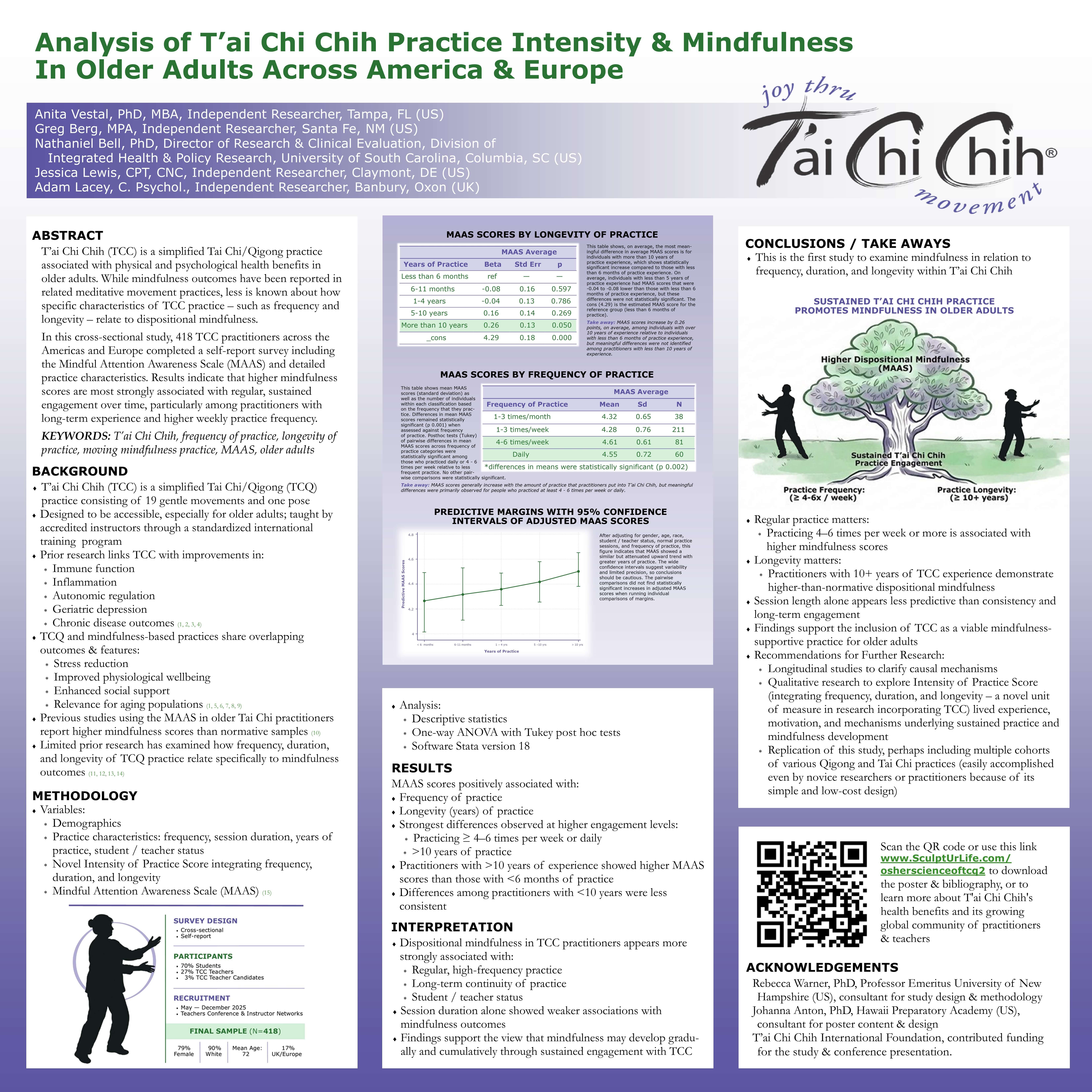
an evidence-based moving mindfulness practice, please read on.
T'AI CHI CHIH & WHOLE-PERSON HEALTH T’ai Chi Chih (TCC) is a brief, manualized, and standardized form of TCQ that supports physical, emotional, and psychological wellbeing.
Rooted in simplicity and ease of practice, TCC can be engaged by people of all ages, abilities, and backgrounds — whether as a personal practice or within clinical, community, and research settings.
T'AI CHI CHIH: Adaptive & Versatile in Practice, Grounded in Research (for more videos, including complete silent standing and seated practices, click the the YouTube icon at the bottom of the page.)
TCC has no martial application. Instead, it is considered an evidence-based moving mindfulness practice that inherently cultivates the free flow of intrinsic energy, awareness, and many other facets of physical and mental wellbeing.
It sits within a growing field of mind-body movement practices increasingly recognized as central to whole-person health: a paradigm rooted in the understanding that health is not simply the absence of disease, and that patient-centered healing requires attention to the complex, interconnected systems of body and mind. Emerging research continues to explore how TCC influences multiple physiological systems — including nervous system regulation, immune function, inflammation, emotional processing, and resilience — contributing to a more integrated understanding of mind-body interaction.
A PRACTICE WITH BROAD REACH & APPLICATION Because of its adaptability, TCC is being integrated across a wide range of contexts, including: · healthcare and rehabilitation settings · psychotherapy and mind-body interventions · resilience and stress-reduction programs · community and public health initiatives · personal wellbeing and contemplative practice
While TCC is widely used with specialized populations, it is fundamentally a practice suitable for anyone. Its accessible and scalable nature allows it to meet individuals where they are, while also supporting structured programs for those navigating more complex health or life challenges.
THE SCIENCE OF MIND-BODY INTEGRATION Research on TCC is helping to clarify how mind-body practices influence interconnected physiological systems, pointing to shared pathways linking movement, attention, and health.
Randomized controlled trials have explored TCC's impact across diverse populations — including older adults experiencing late-life depression, cancer survivors, and individuals managing chronic health conditions. These findings highlight TCC’s potential as an accessible, evidence-informed approach within whole-person health frameworks.
FROM RESEARCH TO LIVED EXPERIENCE The physiological and psychological effects of practicingTCC are reflected across a wide range of real-world settings and applications, including: · military and law enforcement personnel, and those living with PTSD, depression, or suicidality · individuals with progressive neurological disorders like MS, Parkinson's, plus various forms of dementia & cognitive decline · people experiencing degenerative aging & mobility challenges · individuals in substance use disorder (SUD) recovery & rehabilitation · unhoused individuals · incarcerated populations
VOICES FROM PRACTICE One of the most striking examples of TCC’s long-term impact can be found in programs such as those at Folsom State Prison (California), where Accredited instructors have offered weekly classes since 1998. The following reflections from Folsom students illustrate the depth of personal impact that can emerge through consistent practice:
"I do T’ai Chi Chih every day in my cell. I grew up doing movements like these with my Grandma and my Mom ... in a small village in Fiji. I have over 100 stab wounds on my body. I’m sensitive to people’s energy – and this class is healing the wounds I have on the inside. This class contributes to my 24 years of sobriety from heroin. It heals the pain from my childhood and my addiction. It’s how I get ‘high’ now.”
“I’m only 23 and a veteran from the War in Iraq. When I came home, my Post Traumatic Stress was bad and I got into trouble. I came in here wound up pretty tight. I don’t know what I’d have done without this T’ai Chi Chih class and my teacher's support. When I get out, I can’t wait to go and do it in a park under the trees. There’ll probably be these old ladies in the park doing theirTaiji, and they’ll just laugh at me with all my tats, doing my T’ai Chi Chih.”
“I’ve been in this T’ai Chi Chih class for 4 years. The pain in my body is gone and I feel good. When I get out, I want to be a teacher, to pass this along to others; to share this calm. Once you have it, it stays with you.”
“Life gets better and better, the more I practice. I do T’ai Chi Chih in the yard, on the tier, anywhere I can … In class, when we hit that right momentum, the universe stops ... the universe is taking care of me.”
“I believe it’s so important in martial arts to have balance with something like T’ai Chi Chih. As I began to focus on different movements in here, I had a quick appreciation for how peaceful I felt very quickly … I’ve been trying very hard to reform myself for a long time, and the balance, polarity, softness – these are all things I’ve needed in my life. I recently went before the Parole Board (I’ve been in prison 31 yrs) and they focused on this class … The Board was impressed. They saw how it’s had a genuine effect on me, so they found me suitable for parole.”
LOOKING FORWARD As interest in mind-body practices within healthcare and research continues to grow, TCC offers a uniquely accessible and scalable approach that bridges traditional wisdom with emerging scientific insight.
Its capacity to support regulation across physiological systems, while remaining simple enough for widespread adoption, positions TCC as a meaningful contributor to the evolving field of whole-person health.
.png)