December 28, 2025
Ever walk into a room and then completely forget why you did? I hate to admit it but it’s happening to me more and more often all the time. (And I bet I’m not the only one who, when it happens, wonders “is this how Alzheimer’s starts???”) The good news is it’s probably more likely the case that I, just like most people, simply have too much on my monkey mind LOL.
Years ago, while working within the Functional Medicine industry, I was introduced to a groundbreaking book called The End of Alzheimer's: The First Program to Prevent and Reverse Cognitive Decline by Dr. Dale Bredesen. Although research has continued to evolve since its publication, the book remains a benchmark in our understanding of cognitive decline and, more importantly, how it can often be both PREVENTED AND SLOWED.
According to the latest annual report by the Alzheimer's Association, approximately 7.2 million Americans are living with Alzheimer's, and the disease is currently the seventh-leading cause of death. But I think the most heartbreaking facet of this condition is the way it literally steals the lives of both victims and their caregivers sometimes decades before it actually causes the victim’s death.
And YES, apparently genetics matter! We now know lots more about gene variants like ApoE4, which can increase risk.
But here’s a crucial point that often gets missed by many in the standard western medical space: having a genetic risk factor does not mean cognitive decline is inevitable. In fact, the vast majority of people — including ApoE4 carriers — can dramatically influence how their genes express themselves through daily lifestyle choices.
In other words, genetics may load the gun but lifestyle pulls the trigger.
So if we were to boil everything we now know about maintaining (and even improving) brain health down to a single thesis statement, it would be this:
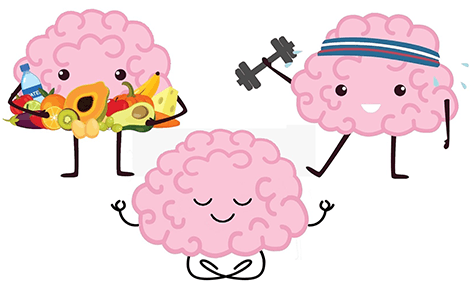
When it comes to either maintaining or even improving brain health, turns out that leveling up just 3 aspects of your lifestyle is typically all it takes:
(WANT BONUS POINTS? Turns out the 3 lifestyle interventions I just mentioned also directly support what I like to call a healthy brain’s 3 BFF’s:
__________________________
First, Eat for Neuroplasticity
Long before memory issues appear, the groundwork has often been laid — sometimes decades earlier — by inflammation, blood sugar dysregulation, and poor metabolic health.
And research from physicians like Dr. Michael Greger (How Not to Die) and Dr. Dale Bredesen consistently shows that nutrition plays a central role in brain health.
Key takeaways from their work includes:
In short: eating in a way that reduces overall inflammation also keeps blood flowing freely to and throughout the brain.
_________________________________________
Next, Move for Plasticity and Proprioception
Exercise doesn’t just strengthen muscles — it changes the brain.
Certain types of movement increase neuroplasticity, meaning your brain becomes better at learning, problem-solving, and adapting to new information. But movement also strengthens proprioception (something many doctors refer to as our "sixth sense"), which helps you balance, coordinate, move safely through the world, and even bring your fork to your mouth (rather than your eye.)
As we age, proprioception is often one of the first senses to decline (which is just one reason balance and fall risk become such big issues later in life!)
So physical movements that are:
… double as brain exercises too!
_____________________________________
And Finally, Relax for Peace and Repair
Sleep deprivation, chronic stress, and nervous system overload are among the strongest contributors to cognitive decline.
Thus quality sleep, appropriate mental challenges, and relaxation practices that not only increase neuroplasticity but actually calm the nervous system too aren’t just optional luxuries as we age — they are foundational to brain health.
So this is where mindfulness-based practices shine (but also where T’ai Chi Chih SPECIFICALLY stands out from the crowd!)
Why?
____________________________________
All that being said, I imagine that many of you are suddenly feeling curious about an upcoming event (which I promise you won’t want to miss!)
My AMAZING ASSOCIATE Jennifer Warriner Eskridge and I have completely rebooted my UNIQUE “MISSING PIECES: Maintaining Brain Health” workshop to accommodate the virtual platform. This lively discussion will be packed with tips and cutting-edge research on all the best ways to protect and maintain brain function including:
And of course everything will be grounded in both rock-hard science and real-world application.
So grab your comfortable clothes, a pen, a notepad, and your open mind, then join in RIGHT FROM YOUR LIVING ROOM!
Just click http://bit.ly/1-13-26VIRTUAL_MissingPieces for more info or just call 302-593-5005 to register BY JANUARY 9TH … signing up for this workshop is a SERIOUS no-brainer!